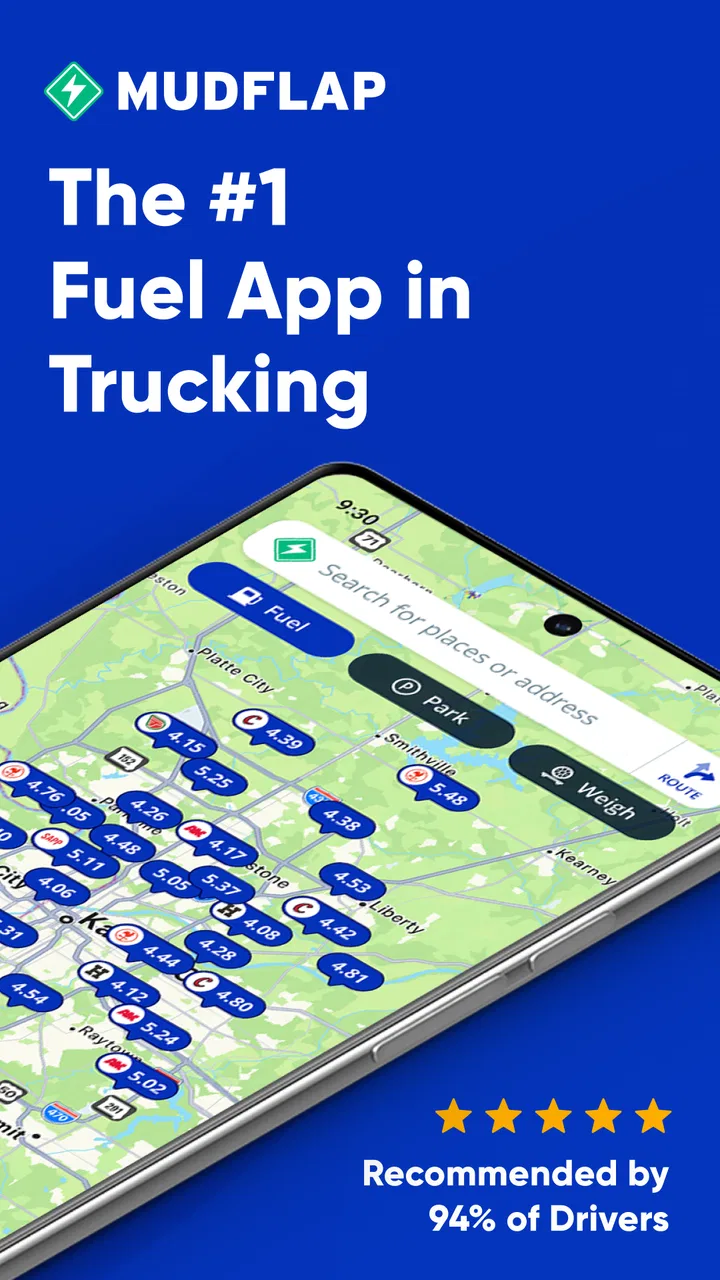
Mudflap
- 4.4
- Rating
- 1.00M
- Installs
- Free
- Price

 Analysis by App-foxy
I usually judge a fuel-saving app by what happens after the first enthusiastic fill-up. A large discount can feel useful once, but the real question is whether the app still earns a place on my phone when I am tired, in a hurry, or driving a route I know well. Mudflap is built around that practical test. It is a free Maps & Navigation app from Mudflap that helps drivers look for diesel discounts and use them during refueling.
My first impression is straightforward: this is not trying to replace a full navigation service. Its value is more focused. If you regularly buy diesel, it can become a companion to the map app you already use, especially when the saving is visible before you commit to a station. The app has been available since late 2019, and its current version is 3.31.2, which gives it the feel of an established tool rather than a short-lived experiment.
What Mudflap feels like during the first week
The first week is when Mudflap makes its strongest case. I would install it before a longer drive, open it when planning a fuel stop, and compare the available diesel offers with the stations I would normally consider. That small change in routine matters: instead of treating fuel as an unavoidable purchase made at the nearest convenient pump, I start thinking about the stop as a decision that can be checked in advance.
You May Also Like

 Blood Strike: 2.5 Anniversary
Blood Strike’s Loadouts Turn Every Drop Into a Tactical Gamble
A close look at Blood Strike’s custom loadouts: how fast access to signature weapons reshapes its battle royale rhythm, rewards preparation, and narrows the gap between fights.

 Pandora - Music & Podcasts
Pandora’s Music Is Easy to Start, but Harder to Recover
Pandora’s strength is its low-effort path from a seed to a station. Its weak spot is how much confidence it asks you to place in connection, setup, and quiet recovery.

 8 Ball Pool
 Is Built on Rivalries, Rematches, and Routine
A close look at the rivalries, rematches, shared routines, and unanswered safety questions that turn a quick pool match into a persistent mobile community.

 Samsung Music
’s Quiet Strength Is Playing What You Already Own
Its reach comes less from spectacle than from dependable access to a personal library. That simplicity is both the app’s strongest retention engine and its ceiling.

 AccuWeather: Weather Radar
AccuWeather Review: A Quick, Clear Forecast for Everyday Decisions
For everyday plans, the best forecast is the one you can understand quickly. AccuWeather makes rain timing, radar, and local conditions easy to act on, with a few trade-offs.

 Hill Climb Racing
Why Hill Climb Racing Still Turns Crashes Into One More Run
A tiny car, a bumpy hill and one more upgrade: Hill Climb Racing keeps resurfacing because its simple chaos makes every near-miss feel personal.
More From Our News Desk



The appeal is clearest for drivers who fill up often. A commuter, delivery driver, road-tripper, or household with a diesel vehicle has more opportunities to benefit than someone who refuels only occasionally. The app’s store summary centers on instant diesel discounts, and that focus is important. I would not install it expecting broad travel planning, walking directions, public transit information, or a complete replacement for a traditional map. Its job is narrower, and the narrower job is easier to understand.
During an ordinary weekday scenario, I might notice that the fuel gauge is getting low while leaving work. Rather than waiting until the warning becomes urgent, I can check Mudflap before starting the drive home. If a participating option fits my route, I can decide whether the saving justifies the extra stop. If it is several minutes away in the wrong direction, the app has still helped me make an informed choice, because the cheapest-looking option is not automatically the cheapest overall once time and distance are included.
That is one of the first useful habits I developed: I treat the displayed discount as one part of the calculation, not as an instruction. A station that requires a detour may erase the benefit through extra fuel and lost time. Mudflap is most helpful when it supports a stop I was already likely to make, or when several stations are close enough that comparing them does not disrupt the journey.
Another practical point is to check the app before reaching the station, not while sitting at the pump. That gives me time to read the offer, understand the process, and decide whether I am comfortable using it. It also avoids the pressure of making a rushed choice with a line of cars behind me. For a first-time user, learning the flow in a calm moment is more sensible than treating the first attempt as an emergency refueling solution.
The app is free to download, and its Everyone content rating makes it approachable for a broad audience. It has passed the early adoption stage as well, with more than half a million installs and an average rating of 4.3 from roughly four thousand ratings. Those figures suggest that the basic idea resonates with many drivers, although they do not remove the need to see whether the available offers fit a particular route or vehicle.
The saving is useful only when the workflow remains simple
In my experience, fuel discounts are persuasive when they reduce mental work rather than add to it. Mudflap has a clear purpose, so it is easier to understand than a general rewards platform filled with unrelated promotions. I can open it with one question in mind: where can I get a better diesel deal that makes sense for this trip?
That simplicity is also a boundary. The app is more compelling for diesel drivers than for people who use petrol, electric vehicles, or several vehicle types and want one universal fuel-planning tool. Someone who rarely buys diesel may find that the extra app, account steps, and checking routine are not worth maintaining. In that case, a normal map search or the station’s own loyalty program may be more convenient, even if it does not offer the same kind of focused discount search.
I also would not rely on it as my only navigation reference. A dedicated map app is generally better for live traffic, complex route planning, lane guidance, and the full journey from door to door. My preferred setup is to use Mudflap for the fuel decision and a conventional navigation app for the drive itself. That division of labor feels more reliable than forcing one specialized tool to handle every part of the trip.
Why the value can survive from month to month
The first-week novelty fades quickly. After that, Mudflap has to justify the seconds spent opening it before each meaningful fuel purchase. Its long-term value depends less on exploration and more on repetition: I need to remember it at the right moment, compare a realistic set of options, and use the saving often enough for the habit to feel natural.
For a high-mileage driver, that recurring pattern can be compelling. The app is not something I would open for entertainment or casual browsing. I would keep it because fuel is a repeated expense. Every time it helps me choose a suitable discounted stop, it has a practical reason to remain installed. This is a stronger foundation for long-term use than a one-off coupon, because the underlying need returns whenever the tank needs attention.
The best monthly workflow is to check before a planned refueling window. I would look at the route, identify whether a discounted station is already nearby, and then decide based on convenience. This prevents the common mistake of opening the app only after the fuel warning appears. Once the tank is nearly empty, flexibility disappears, and I may accept the nearest option regardless of what the app shows.
For people who drive predictable routes, the habit can become almost automatic. A regular commuter might check before leaving for work or before the return trip, while a professional driver could make the check part of a scheduled break. The app becomes more useful when attached to an existing routine rather than treated as a separate task that must be remembered from scratch.
There is also a useful distinction between a discount and a budget strategy. Mudflap can help me find a better price, but it does not replace basic fuel planning. I still need to consider the distance to the station, the amount of diesel I actually need, and whether stopping there fits the rest of the journey. I would avoid driving out of my way for a small saving unless the route, timing, and fuel level already make the stop sensible.
That trade-off is especially important for occasional users. If I fill up only once in a long while, I may not develop enough familiarity with the app to make it feel effortless. A station loyalty scheme that works automatically at a familiar location could be better for me, even if its savings are less flexible. Mudflap rewards attention; the best alternative for a light user may reward consistency with less attention.
How it compares with ordinary map searches and loyalty apps
A normal map app answers a different question: what places are nearby, and how do I get there? It may show stations, but it is not necessarily designed around comparing diesel discounts as the central task. Mudflap is more focused at that moment. When price matters most, I would rather use a dedicated discount view than search through a general map and inspect stations one by one.
On the other hand, a general map remains stronger for the wider journey. It can be the better choice when I need traffic conditions, a multi-stop route, business hours, or directions that continue after refueling. I see Mudflap as an information layer for the fuel stop, not a complete substitute for the navigation tools already built into my phone.
Station-specific loyalty apps can be more convenient for drivers who always use the same brand. They may keep payment, receipts, rewards, and fueling history in one place, depending on the service. Mudflap is more attractive when I am willing to compare options instead of committing to one network. The choice comes down to whether I value breadth of comparison or the lowest-friction experience at a familiar station.
That comparison also explains why the app may not suit everyone. If my only priority is arriving at the nearest station with no extra decisions, Mudflap can feel like work. If I want to make a more deliberate diesel purchase and am willing to check before stopping, its focused approach makes more sense.
Maintenance, friction, and the reasons fatigue can appear
The maintenance burden is not technical in the way a large creative or productivity app might be. The main burden is behavioral. I have to remember to open Mudflap, pay attention to the current offer, and decide whether the station is genuinely convenient. That is manageable for frequent drivers, but it can become background noise for people who do not refuel regularly.
Keeping the app installed is easy to justify when I use it repeatedly. The harder question is whether I will remember it at the exact moment it matters. A useful solution is to place it near my other driving tools, rather than burying it in a folder. I would also make checking it part of the same routine as reviewing the route, not something I try to recall only after pulling into a station.
Another source of fatigue is comparison overload. Discounts can encourage me to keep searching even when I have already found a reasonable option. I find it better to set a simple rule: compare the stations that fit my route, then stop once the likely saving is not worth another detour. This keeps the app from turning a routine fuel stop into an unnecessary optimization exercise.
There is a practical emotional cost too. If I expect every search to produce a perfect deal, ordinary results may feel disappointing. I get more lasting value when I judge the app by whether it occasionally improves a purchase I was already going to make, rather than demanding a dramatic saving every time. That mindset is important because the usefulness of any location-based discount tool depends on where I am driving and when I need fuel.
I would also avoid waiting until the last possible moment to learn the process. A first use at a busy station can be stressful if I am unsure what to tap or what information to check. Exploring the interface before a real fuel stop is one of the more valuable preparation steps. It turns the app from an unfamiliar extra step into a tool I already understand when the tank is low.
Updates are part of the long-term picture as well. The current release is 3.31.2, and I would keep the app reasonably current because discount and station information is the kind of content that benefits from an up-to-date application. I would not treat an old installation as a permanent set-and-forget tool. Checking that it opens properly before a long drive is a small precaution that avoids relying on an app I have not touched for months.
When I would skip it
I would skip Mudflap if I did not drive a diesel vehicle, if my refueling pattern was extremely infrequent, or if I always used one familiar station and already had a frictionless loyalty routine there. I would also skip it when a trip is so time-sensitive that even a short diversion is unacceptable. In those situations, the nearest suitable station and the fastest route matter more than comparing offers.
I would be cautious about making it the centerpiece of a professional driving workflow without first testing it on ordinary trips. A driver who depends on predictable stops needs a process that remains comfortable under pressure. Mudflap may fit that role, but the right way to find out is to use it during low-stakes refueling before depending on it for a demanding schedule.
Finally, I would not recommend it to someone looking for a complete navigation suite. The category label is Maps & Navigation, but its practical identity is a diesel-discount companion. If the main need is turn-by-turn guidance, traffic avoidance, public transport, or broad place discovery, a full map service is the better primary tool.
Does it deserve a permanent place on my phone?
For me, the answer depends on driving frequency, but Mudflap earns a lasting place more convincingly than many discount apps because it addresses a recurring expense. The strongest case is a driver who buys diesel regularly, travels routes with several plausible fuel stops, and is willing to check before committing. That person can turn the app into a small but repeatable part of trip planning.
The lasting value does not come from opening it constantly. It comes from using it at the right moments. I would keep it available for planned refueling, longer journeys, and unfamiliar routes where I have more flexibility. I would not feel guilty about ignoring it when the nearest station is clearly the sensible choice. A good tool should improve decisions, not make every decision feel like a contest.
Mudflap is free and rated for Everyone, so the barrier to trying it is low. Its 4.3 average across about four thousand ratings and its broad install base indicate that the concept has found an audience, while the developer, Mudflap, has continued maintaining the app through its current release. Those details support trying it, but the real test remains personal: does checking it fit naturally into the way I refuel?
My final recommendation is to use it alongside, not instead of, a standard navigation app. Give it a few normal fuel stops rather than judging it from a single search. Compare the offer with the time and distance involved, learn the process before you are in a hurry, and decide whether the habit saves enough effort or money for your driving pattern.
Mudflap is most worthwhile when diesel savings become part of a calm, repeatable routine rather than a frantic search at the last minute. If that routine matches your life, the app can remain useful long after the initial curiosity disappears. If you want instant, no-decision navigation or rarely buy diesel, the usual map or loyalty alternative will probably feel better. For regular diesel drivers who are comfortable making one extra check before filling up, I think this focused tool has a credible reason to stay installed.
FAQs for Mudflap
01What is Mudflap and how does it work?
Mudflap is a mobile app designed to help truck drivers find and pay for fuel at discounted prices. By using the app, drivers can locate participating fuel stations, check current prices, and make payments directly through the app. This service aims to reduce costs and streamline the fueling process for truckers.
02Is Mudflap available on both Android and iOS?
Yes, Mudflap is available for download on both Android and iOS platforms. Users can access the app through the Google Play Store or the Apple App Store. The app is designed to be user-friendly, ensuring a smooth experience across different devices and operating systems.
03Are there any fees associated with using Mudflap?
Mudflap does not charge users any fees for downloading or using the app. The service is free, and the discounts on fuel are directly applied at participating stations. However, it's important to ensure your device is connected to the internet to use the app’s features effectively.
04How secure is the payment process on Mudflap?
Mudflap employs industry-standard security measures to protect user payment information. The app uses encryption and secure servers to handle transactions, ensuring that your financial details remain confidential and safe from unauthorized access. Always keep the app updated to benefit from the latest security enhancements.
05What should I do if I encounter issues with the app?
If you experience any issues with Mudflap, you can reach out to their customer support team via the app or through their website. The support team is generally responsive and can assist with technical problems, account inquiries, or feedback. Additionally, checking for app updates can resolve many common issues.
Pros
- User-friendly interface for easy navigation.
- Wide network of participating gas stations.
- Real-time fuel price updates.
- No hidden fees or subscription costs.
- Secure payment processing.
Cons
- Limited to specific regions.
- Requires stable internet connection.
- Not compatible with all devices.
- Occasional app crashes reported.
- Customer support response can be slow.

Mudflap
Gallery